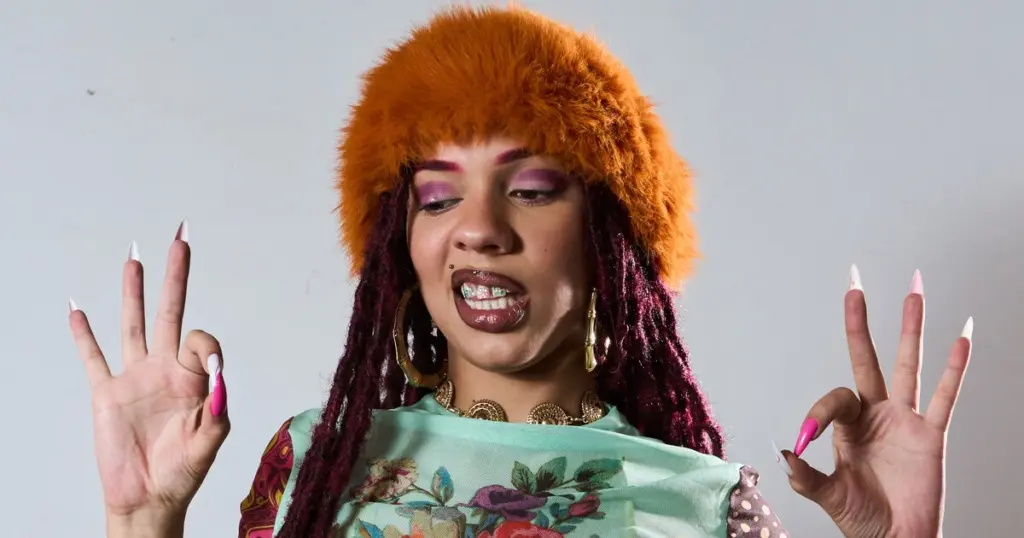
At just 18 years old, Brazilian rapper Ciça is quickly becoming one of the names to watch in the country’s new hip-hop generation.
The Belo Horizonte-born artist, now based in São Paulo, has built a growing audience around boom-bap production, sharp lyricism and a style influenced by the hip-hop culture she grew up around. Despite beginning her official release career only in 2024, Ciça has already surpassed 212,000 monthly listeners on Spotify, according to Billboard Brasil.
Her rapid rise has made 2026 an important year in her young career.
One of the biggest moments came with “MINA QUENTE,” a collaboration produced by her father, veteran Brazilian rapper and producer Slim Rimografia. The track has surpassed 900,000 Spotify streams, helping push Ciça’s music beyond the audience that had already been following her independent releases.
Growing Up Around Brazilian Hip-Hop
Ciça’s connection to rap goes back much further than her first recordings.
She is the daughter of Slim Rimografia, an established figure in Brazilian hip-hop, and rapper Bárbara Sweet, who has been involved in Belo Horizonte’s rap scene and the city’s famous Duelo de MCs culture.
Growing up surrounded by artists, songwriting, production and hip-hop culture gave Ciça an unusual introduction to the music industry.
Her father also produces her music under the name Bruce Slim Beats and performs as her DJ, making the family connection part of her artistic journey rather than simply a piece of her biography.
But Ciça is increasingly establishing an identity of her own.
Her songs focus on personal experiences, ambition, insecurities and the transition into adulthood. Rather than relying solely on her family history, she has been building her audience through her own writing and music.
From Independent Releases to AFROPUNK
Ciça’s growing momentum earned her a place on the lineup of AFROPUNK Experience Rio de Janeiro, where she performed on August 15 at Terreirão do Samba.
The Rio edition brought together artists from different areas of Black Brazilian music, including Rachel Reis, Psirico, Slipmami, Afrolai and Carlos do Complexo alongside Ciça. The event’s lineup reflected the increasingly broad relationship between rap and Brazil’s wider urban music scene.
For Ciça, appearing at AFROPUNK represented another step in her transition from promising newcomer to artist capable of commanding major festival platforms.
The festival’s organizers have positioned the AFROPUNK Experience as a way of connecting different cities, generations and musical scenes before the main AFROPUNK Brasil event in Salvador later this year.
“MINA QUENTE” Changes the Conversation
While Ciça had already begun building a catalogue, “MINA QUENTE” became an important turning point.
The track helped introduce her to a wider audience while maintaining the boom-bap foundation that has become one of the defining characteristics of her music.
Her earlier songs include “Entre Vielas e Avenidas,” “Tranquila & Calma,” “Bonde do Esculacho” and “Subindo e Descendo.” Her catalogue remains relatively small, but the numbers surrounding it suggest that her audience is growing quickly.
Ciça was also selected as one of the ambassadors for Spotify’s AMPLIFIKA program and released “Foca em Mim” as part of Spotify Singles in June 2026.
Those opportunities have helped put the young rapper in front of audiences beyond Brazil’s independent rap circuit.
A New Generation of Brazilian Rap
Ciça’s rise is also part of a broader development in Brazilian hip-hop.
The country’s new generation is increasingly diverse in sound, geography and identity. While trap and melodic rap dominate parts of the mainstream, artists such as Ciça continue to demonstrate that there is still an audience for traditional hip-hop production and lyric-focused rap.
Her emergence also adds another young female voice to a Brazilian rap scene where women are becoming increasingly visible.
In 2025, Ciça was highlighted by rapper Ebony as one of the country’s promising new rap artists during the WME Awards. Her music has since continued appearing in editorial playlists and gaining traction through social media.
That trajectory makes her particularly interesting to watch as the Brazilian rap scene moves into the second half of 2026.
What’s Next for Ciça?
Ciça is still at the beginning of her career, but the indicators are already difficult to ignore.
She has a growing streaming audience, a breakout record, major festival exposure and the support of two artists deeply connected to Brazilian hip-hop.
She is also preparing her first EP, giving her an opportunity to show whether the momentum generated by her singles can translate into a larger body of work.
For now, Ciça represents one of the more interesting stories emerging from Brazil’s next generation of rappers.
At 18, she is already moving from the independent scene onto major festival stages—and if her streaming numbers and recent momentum are any indication, Ciça’s biggest chapter may still be ahead of her.
About the Author